What is customer lifetime value (CLV)? Complete Guide 2026
%3F%20Complete%20Guide.avif)

Try Trengo for Free

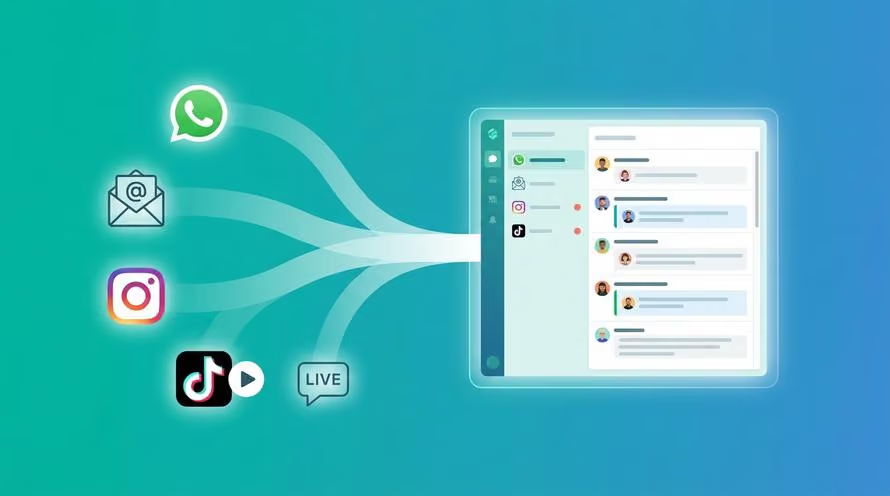
Trengo unites WhatsApp, email, web, social media, and calls in one inbox, saving your team hours of repetitive work and ensures no conversation is ever lost
With the constant rise in ad costs, getting new customers is getting expensive... Really expensive.
That's why smart businesses are shifting their focus from just chasing new leads to making the most of their existing customers. Enter customer lifetime value (CLV)—possibly the most important metric you may not be tracking carefully enough.
In this guide, I'll break down what is customer lifetime value, why it matters to your bottom line, and share some practical ways to boost it (without needing a data science degree).
What is customer lifetime value definition?
At its core, customer lifetime value is pretty simple: It's the total amount of money a customer will spend on your business throughout your entire relationship. It's not about that one-time purchase they made last Tuesday—it's about the bigger picture of their entire journey with your brand.
So, what is customer lifetime value? It’s a metric that helps businesses understand how much revenue a single customer can generate over time. Knowing what is a good customer lifetime value can help companies fine-tune their marketing strategies, enhance customer retention efforts, and maximise profitability.
Think of CLV as a crystal ball that helps you see the long-term value hiding in your customer relationships. It answers the question: "Is this customer worth the effort?"
What is customer lifetime value explained?
When people ask "What is customer lifetime value?", I like to explain using the coffee shop example.
Imagine two customers:
- Sarah stops by your coffee shop every morning for a $5 latte, five days a week, for five years
- Mike visits once, buys a $100 gift card for his office, and never returns
Who's more valuable? Mike's one-time $100 purchase feels significant at the moment, but Sarah's consistent patronage adds up to over $6,500 over time. That's the power of understanding CLV—it reveals who your truly valuable customers are.
The basic math looks like this:
CLV = Average purchase value × purchase frequency × customer lifespan
So for Sarah: $5 × 5 times per week × 52 weeks × 5 years = $6,500
But remember, we're not just talking about revenue—we need to consider profit margins too. If your coffee costs $1 to make and you sell it for $5, your actual CLV calculation would include that 80% profit margin.
Why is customer lifetime value important to businesses?
I've worked with dozens of businesses that were pouring money into flashy customer acquisition campaigns while ignoring the goldmine of existing customers. Here's why focusing on CLV changed the game for them:
Advantages of customer lifetime value
- It saves you money: Keeping existing customers happy is 5-25x cheaper than acquiring new ones. not a typo.
- It helps you spend wisely: Knowing exactly what is the lifetime value of a customer helps you decide how much to spend to acquire or keep them.
- It reveals your VIPs: Not all customers are created equal—CLV shows you which ones deserve the red carpet treatment.
- It predicts your future: When you understand CLV patterns, you can forecast revenue more accurately.
- It gives you breathing room: A high-CLV customer base means more stable income and less pressure for constant new business.
- It makes decisions easier: Should you invest in that new loyalty program? What about faster shipping? CLV gives you concrete numbers to guide these choices.
According to Harvard Business Review, increasing customer retention rates by just 5% can increase profits by 25% to 95%, highlighting why CLV is central to sustainable business growth.
Challenges of customer lifetime value
I won't sugarcoat it—working with CLV has its challenges:
- It's data-hungry: You'll need solid systems to track purchases over time.
- It can get complicated: Different business models need different calculation methods.
- People are unpredictable: Customer habits change, making long-term predictions tricky.
- It takes patience: CLV strategies often don't show results overnight.
- It requires investment: Setting up proper tracking and programs costs time and money upfront.
How to measure customer lifetime value
Let's get practical. Here are three approaches to calculating CLV, from simple to sophisticated:
The historical method
Perfect for small businesses just getting started with CLV:
- Figure out your average sale: Total revenue ÷ number of purchases
- Calculate how often people buy: Number of purchases ÷ number of customers
- Multiply these numbers: Average purchase × purchase frequency
- Estimate how long people stay customers: In years or months
- Get your rough CLV: Multiply the previous result by customer lifespan
For example: if your average sale is $50, customers buy 3 times per year, and typically stay for 4 years, your CLV is $50 × 3 × 4 = $600.
The predictive method
Once you're ready to dig deeper:
- Group customers into cohorts based on when they started buying
- Track each group's spending patterns over time
- Calculate retention rates at different points
- Look for trends in spending behavior as relationships mature
- Compare different cohorts to spot changes in customer value
This method reveals valuable insights like which acquisition channels bring in higher-value customers or which product offerings lead to longer relationships.
Cohort analysis
For businesses with robust analytics capabilities:
- Build predictive models using machine learning
- Incorporate variables like demographic data, engagement metrics, and purchasing patterns
- Factor in churn probability for different customer segments
- Continuously refine your models as new data comes in
Don't worry if this seems overwhelming—many businesses thrive with simpler approaches. The key is to start somewhere.
15 easy ways to improve CLV
After working with companies across industries, I've seen these strategies consistently deliver results:
1. Personalise customer experiences
Generic experiences feel... well, generic. Use your customer data to create moments that feel tailored just for them:
- Send birthday offers that actually arrive on time
- Recommend products based on past purchases (not just what you're trying to clear from inventory)
- Remember their preferences so they don't have to repeat themselves
A client in retail saw a 23% increase in repeat purchases just by implementing personalised post-purchase follow-ups.
Trengo's customer segmentation guide offers detailed strategies for creating personalised experiences that improve retention and lifetime value.
2. Implement a loyalty program
We've all got wallets full of loyalty cards we never redeem. make yours different:
- Keep it simple—complicated point systems get abandoned
- Offer rewards people actually want (hint: ask them!)
- Create exclusive experiences, not just discounts
- Make benefits visible from day one, not just after months of spending
3. Improve customer onboarding
First impressions matter enormously. a thoughtful onboarding process helps customers get value faster:
- Create a welcome sequence that guides without overwhelming
- Check-in at key milestones to ensure they're successful
- Provide educational resources that match their skill level
- Ask for feedback early to catch issues before they lead to churn
4. Focus on customer success
Customers don't buy your product—they buy the outcome it delivers:
- Define what "success" looks like for different customer types
- Proactively share tips to help them achieve their goals
- Celebrate their wins (make them the hero, not your product)
- Hold regular check-ins to ensure they're getting value
5. Enhance customer service
Research shows that 96% of unhappy customers don't complain—they just leave. Beat this by:
- Responding quickly to support requests (hours, not days)
- Training your team to listen for underlying issues
- Following up after problems are "resolved" to ensure satisfaction
- Empowering frontline staff to make things right without manager approval
6. Develop cross-selling strategies
Not all cross-selling feels pushy. Done right, it actually helps customers:
- Suggest products that genuinely complement what they've already bought
- Time recommendations for when they'll be most relevant
- Share how other similar customers use product combinations
- Create bundles that offer better value than individual purchases
7. Implement strategic upselling
The key to successful upselling is demonstrating clear additional value:
- Show specifically how premium features solve their unique challenges
- Let them test-drive higher-tier features temporarily
- Create smooth upgrade paths that don't require starting over
- Time upgrade offers when customers have experienced success
8. Collect and act on customer feedback
Feedback only matters if you act on it:
- Ask specific questions that yield actionable insights
- Close the loop by telling customers how their feedback led to changes
- Identify patterns across feedback to prioritise improvements
- Reward customers who provide valuable input
The Nielsen Norman Group has found that organisations that systematically incorporate customer feedback see significantly higher satisfaction scores and retention rates.
9. Reduce customer effort
Each extra click, form field, or step costs you money:
- Audit your entire customer journey for pain points
- Enable one-click reordering for repeat purchases
- Save customer preferences to avoid repetitive information entry
- Create self-service options for common requests
10. Develop a win-back strategy
Former customers are 3-4x more likely to convert than new prospects:
- Create an early warning system to identify at-risk customers
- Develop targeted offers for different lapsed customer segments
- Address their specific reason for leaving (if you know it)
- Make returns as easy as possible—no punishment or guilt trips
11. Build a community around your brand
Communities create powerful switching costs:
- Create spaces for customers to connect with each other
- Recognise and reward community contributors
- Facilitate knowledge sharing among members
- Host events (virtual or in-person) that strengthen relationships
12. Optimise pricing strategy
Pricing affects both acquisition and retention:
- Test different models to find what drives long-term value
- Create appropriate tiers for different customer segments
- Consider subscription options to increase predictability
- Ensure pricing communicates value, not just cost
13. Improve product quality
No amount of loyalty programs can compensate for a subpar product:
- Prioritise fixes for common customer pain points
- Regularly refresh features based on usage data
- Maintain consistent quality across the entire experience
- Invest in backstage improvements (like load times), not just flashy features
14. Leverage automation for retention
Automation helps you maintain relationships at scale:
- Set up milestone check-ins throughout the customer lifecycle
- Create triggered campaigns for specific behaviors (like cart abandonment)
- Implement renewal reminders with plenty of advance notice
- Use AI-powered tools to spot potential churn signals
Trengo's Retention Automation Solutions provide powerful tools to create personalised, automated experiences that keep customers engaged throughout their lifecycle.
15. Train customer-facing teams
Customer lifetime value isn't just a marketing metric:
- Educate everyone about how their role impacts CLV
- Share customer success stories across departments
- Link compensation to retention metrics, not just acquisition
- Celebrate when long-term customers reach milestones
Measure and improve your customer lifetime value with Trengo
I have seen businesses struggle with disconnected communication channels that make customers repeat themselves and feel unvalued. This is where Trengo shines, especially for consumer service businesses like hotels, restaurants, and automotive companies.
Trengo brings all your customer conversations into one place—whether they reach out via email, chat, social media, or phone. this means:
- Your team gets complete context for every interaction
- Customers receive consistent service across channels
- You can easily identify and prioritise high-value customers
- Automation handles routine tasks while your team focuses on relationships
- You gather insights that help you understand what drives customer loyalty
A hotel client of mine used Trengo to track guest preferences and previous stay information, allowing them to create personalised experiences that increased repeat bookings by 34% in just six months.
The platform's analytics also help you identify which touchpoints most influence CLV, so you can focus your improvement efforts where they'll have the biggest impact.
Ready to transform one-time customers into lifetime fans? That's where the real money is in 2026.



Let's meet
Grow your business with loyalty. Bring all of your customer contact into one, single platform to unlock delight at every step of the way.