Live chat vs email support: Key differences between live chat & email


Try Trengo for Free

Trengo unites WhatsApp, email, web, social media, and calls in one inbox, saving your team hours of repetitive work and ensures no conversation is ever lost
When deciding how to best connect with customers, one common question arises: Should your team rely more on live chat or email support? Both channels have strengths that can make them the right choice in different situations. For some customers, the immediacy of live chat feels reassuring, while others appreciate the flexibility and detail offered by email.
Each option comes with its own set of advantages and challenges, as well as unique skill requirements for the customer service teams that manage them. In this blog, we’ll explore the key differences between live chat and email support, so you can determine which channel—or combination—brings the most value to your customers and your business.
What is live chat?
Live chat is a real-time communication channel that allows customers to connect instantly with support teams through a chat window on a website or mobile app. It’s designed for quick, conversational exchanges—helping customers ask questions, get guidance, or resolve issues without leaving the page they’re on.
Unlike traditional channels where responses can take hours, live chat provides an immediate and interactive experience. Agents can respond in real time, share helpful links, and even guide users step-by-step through complex processes. Many advanced platforms, like Trengo, also integrate automation and chatbots to handle common queries before they reach a human agent—saving time for both teams and customers.
Beyond speed, live chat builds stronger relationships by offering personalised, empathetic support. It turns a simple website visit into an engaging two-way conversation, helping teams deliver customer happiness at scale.
What is email support?
Email support is a customer service channel that allows businesses to assist customers through written communication. It’s one of the most established ways for customers to reach out when they need help with queries, billing issues, or product-related concerns.
With email support, customers can send detailed messages to a dedicated support address and receive responses directly in their inbox. This asynchronous approach gives both parties the flexibility to respond at their convenience—especially for complex requests that require research or internal coordination.
Email remains a valuable tool for maintaining clear documentation, handling multiple customer conversations, and providing thoughtful, personalised responses. Platforms like Trengo make this process even smoother by centralising all email interactions in one shared inbox, ensuring every inquiry is tracked, assigned, and resolved efficiently.
How do live chat and email support work?
Both live chat and email support are designed to help customers get the answers they need, but they operate in very different ways. Understanding how each one works can help you decide which fits better into your customer service strategy.
Live chat works instantly. Imagine you’re exploring a website and a question pops up about pricing or delivery options—you can open the chat widget and start talking with an agent right away. The conversation happens in real time, so issues are resolved within minutes. Some platforms, including Trengo, also use AI-powered chatbots to automatically answer frequent questions or route complex ones to the right team member.
Email support, on the other hand, is more like a structured, written conversation. Customers send a detailed message describing their issue—often with related files or screenshots—and get a response once the support team has reviewed it. This method is ideal for queries that need more context or investigation. Trengo’s shared inbox ensures that every incoming email is tracked, prioritised, and answered on time, helping teams maintain consistency and transparency across all customer communications.
Both methods aim to improve customer satisfaction—the difference lies in how fast and how personally those interactions take place.
Key differences between live chat and email support
While both channels help businesses deliver quality customer service, they serve different purposes depending on customer expectations, team capacity, and the type of interaction involved. Here’s how live chat and email support compare across key areas.
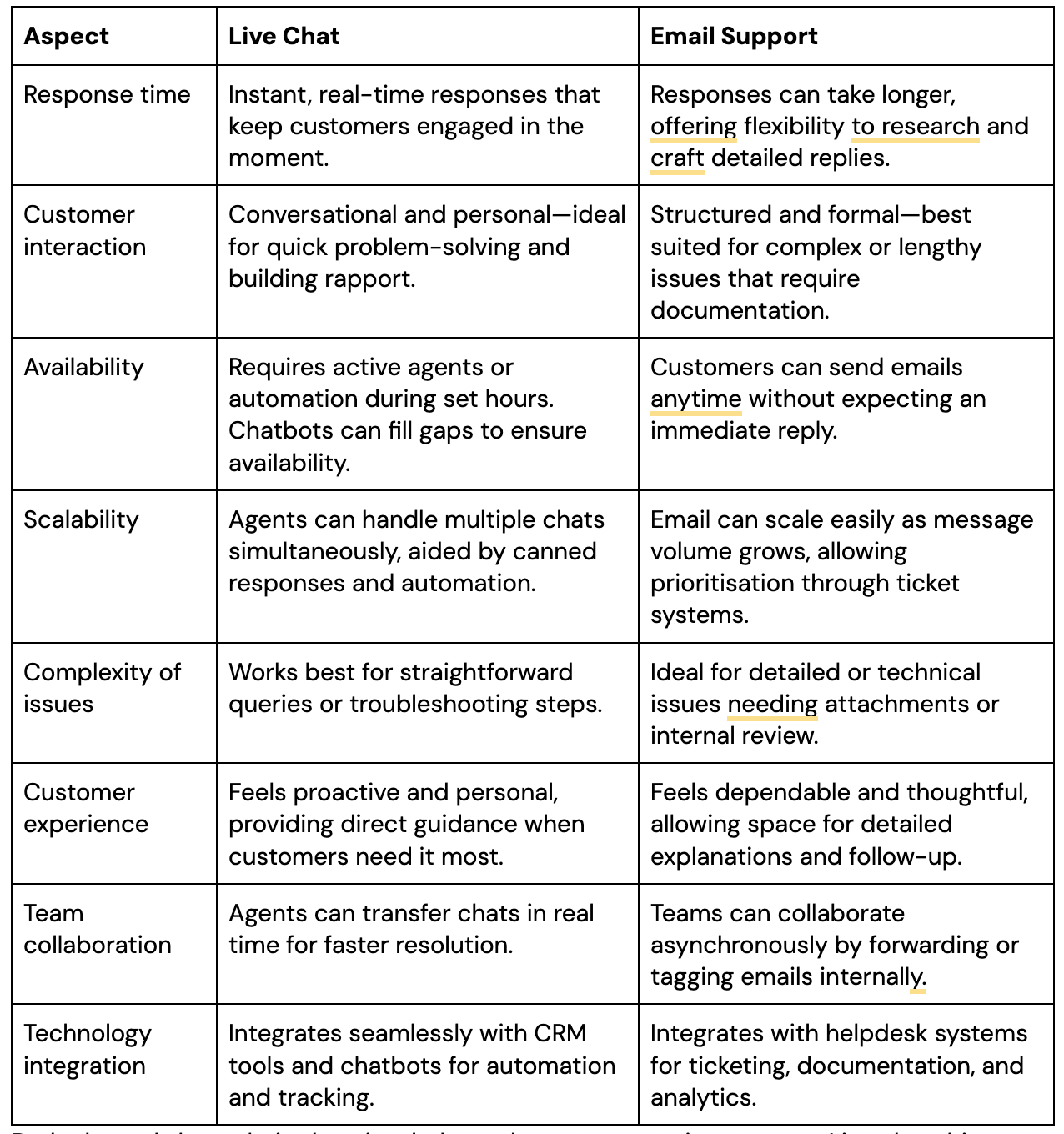
Both channels have their place in a balanced customer service strategy. Live chat drives immediate engagement and quick resolution, while email support ensures thorough, traceable communication. With platforms like Trengo, teams can manage both seamlessly in one workspace—offering customers the right type of support when they need it most.
How to select the right channel for your company
Choosing between live chat and email support depends on your customers, team capacity, and goals. The most effective way to decide is to understand what matters most to your customers and when each channel delivers the best experience.
When does email support make sense?
Email support works best when you need structure, detail, and time to respond thoughtfully. It’s ideal for:
- Complex or technical issues that require screenshots, attachments, or step-by-step instructions.
- Scenarios where a detailed record of communication is valuable for both the customer and the business.
- Businesses that prioritise cost-effective communication at scale—email works across all devices and time zones.
- Teams that need flexibility in managing multiple requests without the pressure of real-time responses.
Email remains the foundation for many support operations because it offers clarity, documentation, and accessibility for nearly every customer.
When does live chat make sense?
Live chat shines in moments when your customers need fast, guided help. It’s best suited for:
- Real-time troubleshooting during shopping, checkout, or onboarding experiences.
- Businesses that want to create instant, human connections to improve conversions and satisfaction.
- Products and services aimed at younger or mobile-first audiences who prefer immediate support.
- Teams ready to blend automation with human interaction using AI-driven chatbots for 24/7 availability.
To make live chat work, coverage and expectation management are crucial. Customers should always know when an agent is available and how long it might take to get a response.
Which channel should you start with?
If your business is new to customer support, start simple. Email support is generally easier to manage with smaller teams and budgets. Once your support operations and response processes are consistent, introducing live chat can help you scale responsiveness and engagement.
Before expanding, ask these key questions:
- What channels do your customers already use or prefer?
- How complex are your typical support requests?
- What resources and coverage can your team realistically maintain?
Balancing these factors will help you create a service mix that feels reliable and responsive—without overwhelming your team.
Rolling out live chat successfully
If you’re ready to implement live chat, plan the rollout carefully to create seamless customer experiences from day one.
- Plan your setup – Define when and where live chat will be available, who will manage it, and how it integrates with your existing systems.
- Match your brand – Customise your chat interface to reflect your brand’s design and tone. A cohesive experience builds trust and professionalism.
- Test before launch – Run internal tests to ensure that notifications, saved replies, and availability settings work as expected.
- Train your team – Equip agents to handle live chat efficiently, using concise language and empathetic communication suited to fast-paced exchanges.
- Set clear expectations – Communicate chat availability upfront, especially if you offer support only during business hours.
- Track and refine – Measure key metrics like chat response time and customer satisfaction regularly to see how live chat impacts the overall experience.
- Collaborate across teams – Once support has mastered live chat, consider extending its use to sales or marketing to support lead generation and engagement.
With an omnichannel platform like Trengo, you don’t have to choose one over the other. You can manage live chat, email, and every other customer channel from one inbox—ensuring consistent, fast, and thoughtful support across every touchpoint.
How to manage both with Trengo
Delivering excellent customer service doesn’t always mean choosing between live chat and email support—it means managing both effectively. With Trengo, your team can handle all customer conversations from one shared inbox, ensuring every message gets the attention it deserves, no matter which channel it comes from.
Trengo’s unified platform brings live chat, email, social media, and messaging apps together in one workspace. This allows teams to switch seamlessly between channels without losing context. Whether an interaction starts as a quick live chat and continues over email or vice versa, your entire communication history stays organised and visible to everyone involved.
Here’s how Trengo helps teams excel across both channels:
- Unified inbox: Bring every customer message—from chat or email—into one view, so nothing gets overlooked.
- Automation and chatbots: Use automation to handle repetitive tasks, route messages to the right team, and provide instant responses even outside business hours.
- Internal collaboration: Tag teammates, leave internal notes, and assign conversations without switching tools.
- Custom workflows: Streamline how incoming questions are prioritised, ensuring urgent chat queries get quick responses while detailed email cases are handled thoroughly.
- Insightful analytics: Track performance metrics like response time, resolution rate, and customer satisfaction across both channels.
By combining Trengo’s automation and collaboration capabilities, your team can create a balanced support strategy—fast, personal assistance through live chat, backed by reliable follow-ups and records through email. It’s how modern customer service becomes both efficient and genuinely human.
Final words
Choosing between live chat and email support isn’t about finding a single “best” option—it’s about understanding how each can serve your customers in different moments. Live chat offers instant, personal interactions that can boost satisfaction and conversions, while email provides flexibility, documentation, and the space to resolve complex issues. The real power comes from combining them in a way that matches your customers’ needs and your team’s capabilities.
With Trengo, you can unify both channels—alongside all your other customer touchpoints—into one clear, efficient workflow. This means faster responses, better collaboration, and a consistent customer experience, no matter where the conversation begins.
Ready to see how Trengo can transform the way you manage customer support? Book your free demo today and experience the difference of truly connected communication.
Frequently Asked Questions (FAQs)
Is email support still effective in 2025?
Yes, email support remains an essential channel in 2025, particularly for detailed inquiries, complex issues, and formal communications. Email allows customers to articulate their concerns fully and receive thorough, documented responses. Despite the rise of instant messaging, many customers appreciate email’s convenience and the ability to keep a record of interactions.
When should a business use live chat instead of email?
Live chat is ideal for situations requiring immediate assistance, quick clarifications, or real-time problem-solving. It reduces wait times, offers instant engagement, and is especially useful for guiding customers during purchasing or troubleshooting. Businesses often use live chat for initial contact, escalating to email for follow-ups or detailed explanations.
Do customers trust live chat more than email support?
Many customers perceive live chat as more trustworthy because it provides real-time interaction, human presence, and transparency. Live chat agents can address concerns instantly, reducing anxiety and building confidence. However, email still holds trust for comprehensive, formal communications where detail and record-keeping are crucial.
Which is better for customer satisfaction: live chat or email?
Both channels contribute to satisfaction differently. Live chat tends to score higher on immediacy and convenience, leading to quicker resolutions and happier customers. Email excels in depth and detailed responses. A blend of both, tailored to customer needs, usually offers the highest overall satisfaction.
Can live chat and email support work together in a customer service strategy?
Absolutely. Integrating live chat and email ensures customers receive fast initial responses and comprehensive follow-ups when needed. This combination offers flexibility, covering simple issues live and allowing time for more complex queries via email, resulting in improved customer experience.
What tools are best for live chat support?
Platforms specialised in live chat, such as Trengo, Intercom, and LiveChat, offer robust features like real-time messaging, chat routing, AI-powered chatbots, and analytics. Trengo excels by integrating live chat within a larger omnichannel platform for unified message management.
What tools are best for managing email support?
Email management is enhanced by tools offering shared inboxes, automation, tagging, and reporting. Trengo combines email support with other channels in a single inbox, streamlining team collaboration and enabling quick, coordinated responses.
Do automation tools work better with live chat or email?
Automation excels in both but serves different purposes. For live chat, automation provides instant replies via chatbots and smart routing to reduce wait times. For email, automation manages ticket creation, follow-ups, and workflow optimisations. Trengo’s automation covers both channels seamlessly to optimise overall service.
How does Trengo combine live chat and email support in one shared inbox?
Trengo centralises live chat messages and email conversations in a single shared inbox accessible to all team members. This enables seamless switching between channels, clear assignment of queries, and faster response, all from one platform without the need to toggle between systems.
Can Trengo show whether live chat or email is delivering higher customer satisfaction?
Yes, Trengo’s analytics provide insights on customer satisfaction scores segmented by channel, allowing businesses to compare performance between live chat and email support. This data helps identify which channel excels and where there’s room for improvement.
How does Trengo’s automation balance instant live chat replies with detailed email follow-ups?
Trengo’s automation sends immediate responses on live chat through AI-powered bots or predefined replies, ensuring no customer waits. For email, it can automate ticket creation, reminders, and personalised follow-ups, maintaining thorough communication without overwhelming agents.



Let's meet
Grow your business with loyalty. Bring all of your customer contact into one, single platform to unlock delight at every step of the way.