B2B email marketing best practices: proven strategies for 2026

Try Trengo for Free

Trengo unites WhatsApp, email, web, social media, and calls in one inbox, saving your team hours of repetitive work and ensures no conversation is ever lost
In 2026, email is still a valuable marketing channel, especially in B2B. According to HubSpot’s 2025 report, 73% of B2B buyers prefer that sellers contact them via email. This makes it the most welcome communication channel for professional relationships.
But you can't be sending out any old emails. Without strategy, segmentation, and clear calls to action, you risk your email going straight to the bin. If you want to stand out, and create emails that your audience actually open and engage with, you’ll need to apply the best practices for B2B email marketing. This means you need to stay relevant and create effective customer engagement strategies that move the needle.
What is B2B email marketing?
B2B email marketing means sending emails from one business to another. These emails can help build trust, share useful information, or move a buyer through your funnel
These emails don't have to be flashy promotions. Often, B2B email marketing is more about staying helpful and relevant than outright pushing for a sale. Most B2B buyers take time to make a choice.
In fact, that time can be as lengthy as 6-12 months, according to cognism. And while this will vary a lot based on your product and audience, in almost all B2B spaces you are dealing with slow decisions that require input from multiple people, so your emails should support them along the way.
You might then decide to use your B2B emails to share:
- A product update
- Send a reminder for a meeting
- Follow up on a demo request
- Customer stories
- Industry insights
When done right, using B2B email marketing best practices, these messages keep your brand top of mind.
At Trengo, we help teams do all of this from one platform. You can organise contacts, personalise your message, and link email with channels like WhatsApp or live chat. All in one place so that it’s easy to manage.
Is email marketing worth investing in for B2B businesses?
You might have heard the phrase “email is dead” thrown around a lot in recent years. The truth? It’s still one of the most reliable ways to reach B2B buyers.
Email remains one of the best-performing marketing channels in terms of return on investment. According to Litmus, email marketing can deliver an ROI of $36 for every $1 spent. That’s higher than most paid ad or social media campaigns.
So why do people think email doesn’t work anymore? Often, they’re thinking about B2C inboxes that end up full of spammy discounts and one-size-fits-all promotions. But B2B email is different.
Here’s why it still works in the B2B market::
Your buyers still prefer it
According to HubSpot’s 2025 report, 73% of B2B buyers say they want to be contacted by email. It’s their preferred channel, especially for thoughtful, low-pressure communication.
You stay in control
Unlike social media, you own your email list. No algorithm changes, no pay-to-play visibility. If someone’s opted in, they want to hear from you.
It fits the B2B buying cycle
B2B deals don’t close overnight. Buyers need time to research, compare options and get internal buy-in. Email helps you guide them through each stage, one message at a time.
You can track and improve
With email, you don’t have to guess what’s working. You can measure open rates, click-throughs, and replies, to refine your approach with real data. Tools like Trengo make this simple.
You can personalise at scale
With segmentation and automation, you can send the right message to the right person at the right time. It feels personal, even when you’re talking to thousands of potential customers.
At Trengo, we see teams use email to share product updates, nurture leads, and stay in touch after support tickets close. When connected to tools like WhatsApp, chat, or Instagram, email becomes even more powerful as part of a full conversation.
Why do B2B emails require B2B strategies?
Writing a strong B2B email is not the same as writing a good B2C email. Even if the format looks the same, what’s inside (the tone, timing, and content) needs to work for a very different decision-making process.
That’s why the B2B email marketing best practices that deliver results go beyond flashy subject lines or one-size-fits-all offers. Here’s what sets B2B email apart, and how to approach it with a smarter strategy.
You're speaking to more than one person
In B2C, you’re often selling to one person. In B2B, your email could reach a marketer, a finance lead, or a product manager, all within the same company. Each of them has different goals and different problems.
That means you need more targeted messaging. With Trengo, you can segment your audience by role, department or industry, so you’re always speaking the right language.
Sales cycles are longer
B2B purchases aren’t impulse buys. A single deal can take months to close, with multiple decision-makers involved. Your emails need to follow that pace and not try to push a sale too fast.
Use automated flows in Trengo to build helpful sequences that match the customer's journey and help them convert. For example, send a product overview after someone books a demo, or a reminder if they’ve gone quiet.
B2B buyers want insights, not offers
B2C emails thrive on discounts and urgency. B2B buyers are looking for value, and they’re more likely to click on an email that teaches them something.
Share a how-to guide, a case study, or an industry insight they can bring to their team. Trengo’s shared inbox makes it easy to send follow-ups, answer questions, or connect over WhatsApp when they’re ready to talk.
B2B decisions take trust
Above all, B2B email is about building trust with your audience. Your emails aren’t just selling a product. They’re helping a buyer justify a decision to their manager, their team, and their budget holder.
That’s why clarity, consistency and relevance are key. And that’s where B2B email marketing best practices come in.
10 proven B2B email marketing best practices
Here are ten clear, actionable B2B email marketing best practices that you can use to start increasing your conversions.
1. Define a clear goal for every email
Before you start writing an email, ask: what’s the point? Every message should serve a clear purpose. This could be:
- To book a meeting
- Confirm interest in your products or services
- Share a resource
- Re-engage a cold lead
Without a goal, your email becomes noise in a busy inbox. This is especially true in B2B, where buyers are time-poor and juggling multiple priorities.
In Trengo, you can connect email actions to broader workflows. For example, when a contact clicks a CTA or replies, you can trigger an automation that notifies a teammate, tags the conversation, or sends the next email in a sequence. These connections give your email real direction, for both you and your recipient.
By tying each message to a clear outcome, you’ll stay focused and help your audience move forward with less friction.
2. Use the right message for the right contact
B2B email is rarely one-to-one. You’re often writing to a team that may include a marketer, a finance lead, or even a CEO. Each person has different priorities, so one message will not work for everyone. That’s where segmentation comes in.
Trengo’s CRM lets you use labels and custom fields to group contacts by role, industry, or buyer stage. A CFO might get a message about ROI, while a marketing manager sees a case study. Both emails serve the same campaign but feel tailored to each reader.
Segmentation also keeps your database clean. When you know who’s receiving what, you avoid sending irrelevant content that leads to unsubscribes. Send the right message to the right contact at the right time. With Trengo, that level of personalisation becomes much easier.
3. Make emails simple and well-structured
Complicated designs and too many CTAs often overwhelm the reader. B2B buyers are scanning their inbox between meetings, so your email should be easy to read and even easier to act on. Stick to one clear focus, keep the design minimal, and use a single clear CTA.
Trengo helps you with this by letting you embed multi-channel CTAs. Instead of just linking to a landing page, you can direct someone to WhatsApp, live chat, or Calendly. This makes it easy for your potential lead to engage in the channel they prefer.
A B2B email marketing best practice is to use short paragraphs, bullet points, and clear headings. A busy executive should be able to skim your message in 30 seconds and still understand the message.
4. Automate thoughtful follow-up sequences
One email is rarely enough in B2B. Buyers need reminders, extra resources, and gentle nudges over weeks or even months. The challenge is doing this consistently without overwhelming your team. That’s where automation comes in.
In Trengo, Flowbot lets you set rules for follow-ups. If someone doesn’t reply after a week, they can automatically receive a case study, reminder, or other prompt. If they engage, the sequence can switch tracks to offer a demo or consultation. This way, you’re not guessing what to send next, you’re guiding them through a journey.
Follow-ups should always give value to the recipient. Instead of repeating the same message, share something useful at each step, for example:
- a blog post
- an industry stat
- a quick how-to.
That way, you stay helpful, not pushy.
Automated follow-ups keep the conversation alive, nurture trust, and move deals forward without putting a huge strain on your team.
5. Link email to the full engagement journey
Email should never exist in a silo. In B2B, buyers move between channels, often starting with an email, then moving to other channels such as WhatsApp and live chat. If these conversations are scattered, you lose context and momentum, not to mention you'll probably frustrate your lead.
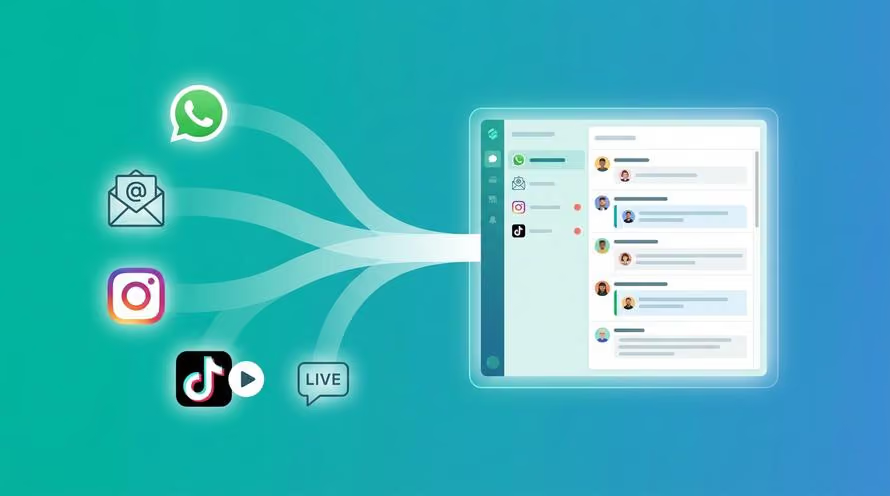
Trengo solves this issue by combining all messages from channels such as email, WhatsApp, Instagram, and live chat into one shared inbox. That means if a potential lead replies by email today and WhatsApp tomorrow, your team still sees the full conversation in one place.
This matters because consistency builds trust. If buyers feel like they have to repeat themselves across channels, they’ll lose patience. But when you can pick up the thread seamlessly, you show that your business is organised and reliable.
6. Map emails to the buyer’s journey
B2B purchases don’t happen overnight. Prospects move through stages such as awareness, consideration and decision, one (often slow) step at a time. Your emails should match where they are, not try to rush them.
For example, early-stage leads may benefit from educational content like blog posts or industry insights. Mid-stage buyers want proof: case studies, testimonials, ROI calculators. At the decision stage, they’re ready for demos, pricing, or a free trial. After purchase, onboarding and success tips can help keep them engaged and ensure they get the full value of your product.
With Trengo, you can design automation flows that align with these stages. A new lead might automatically receive an intro series, while an active customer gets product tips. Labels and triggers help you send the right message at the right moment.
By mapping emails to the buyer’s journey, you create a smoother conversion. Instead of random touches, you deliver relevant guidance every step of the way that's coherent and valuable.
7. Test, learn, and refine with data
No matter how experienced you are, you can't read your mind. That’s why testing is so important. A/B testing subject lines, CTAs, and even send times shows you what gets the best results from your audience.
While Trengo isn’t a standalone A/B testing tool, it integrates with CRMs and ESPs that handle this aspect of your B2B email marketing strategy. You can then pull insights back into Trengo, where you see conversations across channels. This gives you the bigger picture: which subject lines result in replies, which CTAs lead to WhatsApp chats, and what timing gets the most clicks.
The real best practice is to treat email as an ongoing experiment. Use data, not assumptions, to refine your campaigns. But it's also important not to get carried away. Start by testing subject lines and send times and then you can get down to the more refined details in the email content.
8. Personalise beyond a name
Adding someone’s first name to an email is a start, but it’s not enough. Almost any email newsletter you sign up to these days will send out emails with your name on it. True personalisation means tailoring content to the recipient's role, challenges, and past interactions with your company.
Trengo helps here by storing all interactions in one place. If a contact previously reached out via chat about pricing, your next email can reference that. If they downloaded a whitepaper, you can follow up with related content. Every detail makes that potential lead feel more valued and heard, helping to build trust with your company..
Personalisation also extends to timing. You can automate emails based on behaviour. For example, sending a reminder when someone abandons a form, or a thank-you after a demo.
The goal is to make every email feel like it was written for that specific person, even if it’s part of an automated sequence. Done right, this builds trust and keeps your messages out of the spam folder.
9. Reuse templates for speed and consistency
Creating emails from scratch each time is slow and can lead to an inconsistent tone of voice. Templates save time while keeping your communication polished and on-brand.
In Trengo, you can build templates for common messages such as:
- Welcome emails
- Demo confirmations
- Follow-ups
- Newsletters
Every teammate can access them, ensuring your tone and design stay consistent, no matter who’s hitting send, even if the person is brand new to the team.
Good templates aren’t rigid. They provide structure (clear layout, CTA placement, brand elements) while leaving space for personalisation. For example, a demo follow-up template might include a placeholder for the recipient’s specific pain point.
Templates also reduce errors. When design, copy, and CTAs are pre-validated, your team avoids formatting mistakes or off-brand messaging.
This leads to faster moving campaigns, more consistent branding, and less stress for your team.
10. Learn from real customer success
The best proof of these practices comes from businesses already using them. One example is Arthur & Brent, a consultancy that struggled to keep up with growing lead volume. By using Trengo’s Flowbot and automation, they scaled lead intake by 5× and improved response time by 7× — without hiring extra staff.
This case shows how B2B email campaign best practices work in the real world. Clear goals, automation, personalisation, and multi-channel support aren’t just theory. They’re strategies that help teams handle growth with control instead of chaos.
When you apply these practices, email becomes more than a broadcast tool. It becomes a reliable driver of conversations, leads, and revenue. And when paired with Trengo’s platform, your team can do it at scale, without losing the personal touch.
4 B2B marketing email examples that show just how powerful a strategy it is
Your B2B email strategy won’t work if your emails don’t land well with your audience. Here are four examples of B2B email best practices in action and how you can apply them with Trengo.
1. The welcome email
Buyer persona: User
Journey stage: Awareness > Retention
A welcome email sets the tone for your entire relationship. Done right, it reassures buyers that subscribing was worth it. Keep it short, useful, and clear. Share what they can expect from you and provide one strong call to action, like exploring a key feature or booking a demo.
With Trengo, you can automate this flow so every new contact receives a personalised welcome. Use labels to differentiate between roles. For example, a marketer might get a content guide, while a finance lead gets ROI insights. This way, your first email feels relevant, not generic.
2. The product update email
Buyer persona: User, Influencer
Journey stage: Awareness, Retention
Nobody wants to read a self-congratulatory update. Instead, focus on how the new feature makes life easier for your user. For example, a dark mode release should highlight the productivity and comfort it brings, not just the fact that your team built it.
Trengo’s shared inbox makes it easy to link updates across channels. Add a “Chat with us on WhatsApp” button in your email so users can ask questions right away. This keeps your updates interactive and makes the customer feel involved.
3. The resource delivery email
Buyer persona: Initiator, User
Journey stage: Consideration
When someone downloads a report or guide, they’re usually in the middle of a busy workflow. The delivery email should respect that: make the download link obvious, and avoid clutter. But you can still add extra value by including a second, relevant resource.
For example, if a lead downloads your B2B trends report, follow up with a case study showing those trends in practice. Trengo helps automate this, so each download triggers a personalised resource email without manual effort.
4. The event or webinar invite
Buyer persona: User, Buyer, Influencer
Journey stage: Consideration > Decision
B2B event invites need to be clear and to the point. Don't write long intros, just get the essentials across. For example, highlight what the event is, why it matters, and what attendees will gain. A bulleted list works well to showcase takeaways at a glance.
With Trengo, you can send invites via email but also add CTAs to join reminders on WhatsApp or live chat. That way, attendees stay engaged across the channels they use most. After the event, automation rules can trigger thank-you emails or post-event surveys.
Final thoughts
Email isn’t dead, in fact, in B2B, it’s thriving. The key is knowing how to use it. By applying these B2B email marketing best practices, you can turn every message into a step forward in the buyer’s journey. From clear goals and thoughtful follow-ups to multi-channel engagement, the right approach builds trust and drives measurable results.
With Trengo, you don’t just send emails. You manage conversations across email, WhatsApp, live chat, and more, all in one convenient location. That means better control, better insight, and stronger connections with your buyers.
Frequently Asked Questions (FAQs)
What are the best B2B email marketing strategies for 2026?
The best B2B email marketing strategies in 2026 focus on personalisation, automation, and AI-driven insights. Campaigns that combine behaviour-based triggers, dynamic content, and segmented workflows perform the strongest. Using an omnichannel tool like Trengo, businesses can link email campaigns with WhatsApp, live chat, and social channels, ensuring consistent messaging across every customer touchpoint.
What’s the ideal email frequency for B2B campaigns?
The ideal frequency varies by industry, but most B2B companies find that one to four emails per month works well. Sending too frequently risks overwhelming decision-makers, while too little communication reduces brand recall. AI models can now predict engagement windows, helping marketers identify the optimal send times. Platforms like Trengo allow you to test different frequencies and measure engagement rates to fine-tune your approach.
What are the top tools for B2B email marketing in 2026?
Some of the leading B2B email marketing tools include:
- Trengo – Combines email marketing with WhatsApp, chat, and social engagement for unified communication.
- HubSpot – Popular for CRM-driven email workflows.
- ActiveCampaign – Known for advanced automation and personalisation.
- Mailchimp AI – Strong for predictive analytics and segmentation.
Trengo stands out for B2B firms that want to manage email alongside other channels, avoiding fragmented conversations.
Can AI improve B2B email marketing results?
Yes, AI has become central to email marketing success. Large language models (LLMs) help generate personalised subject lines, refine copy, and even predict what content resonates with specific segments. AI also analyses past campaign performance to improve open rates and conversions. For instance, Trengo uses AI-driven workflows to automate responses and create personalised follow-ups across email and messaging channels.
How do I personalise B2B emails without being too pushy?
Effective personalisation is about relevance, not intrusion. Instead of repeating a recipient’s name multiple times, focus on tailoring content to their role, industry challenges, or previous interactions. AI-driven segmentation and predictive analytics make this easier. Tools like Trengo enable businesses to pull context from past conversations—email, WhatsApp, or chat—so that follow-up emails feel natural and value-driven.
How do I measure the success of a B2B email marketing campaign?
Key metrics to measure include:
- Open rate – How many recipients viewed the email.
- Click-through rate (CTR) – How many engaged with the links.
- Conversion rate – How many took the desired action (demo request, meeting booked, etc.).
- Engagement over time – Whether contacts remain active across multiple campaigns.
Platforms like Trengo provide built-in analytics and reporting, helping businesses track not just email results but cross-channel engagement, giving a fuller picture of ROI.
Is email automation important for B2B companies in 2026?
Absolutely. In 2026, email automation is no longer optional—it’s essential. Automated workflows allow B2B companies to nurture leads at scale, send timely follow-ups, and align outreach with the buyer’s journey. With Trengo’s automation features, businesses can go a step further by linking email automation to WhatsApp campaigns, chatbots, and CRM integrations—ensuring no opportunity slips through the cracks.



Let's meet
Grow your business with loyalty. Bring all of your customer contact into one, single platform to unlock delight at every step of the way.