

.png)
What is an ERP System in eCommerce
Summary
An ERP for ecommerce is a unified software system that centralizes and automates core business operations, acting as a single source of truth for everything from inventory and order management to financials and supply chain logistics. For modern eCommerce businesses, integrating an Enterprise Resource Planning (ERP) system is no longer a luxury but a critical step for scaling efficiently. This integration eliminates manual data entry, provides a 360-degree customer view, and empowers data-driven decision-making, ensuring both back-end operations and front-end customer communications work in perfect harmony.
TL;DR
- An ERP system centralizes all core business data, including inventory, orders, financials, and supply chain information, into a single platform.
- Integrating an ERP with your eCommerce store automates processes, reduces human error, and provides a comprehensive view of your business and customers.
- Key benefits include enhanced efficiency, improved data accuracy for decision-making, and the ability to scale operations without a proportional increase in headcount.
- An eCommerce platform is your customer-facing storefront, while an ERP is the operational back office that manages the business behind the scenes.
- The future of eCommerce ERP involves AI and automation, making the integration with a smart communication platform like Trengo even more powerful for customer service.
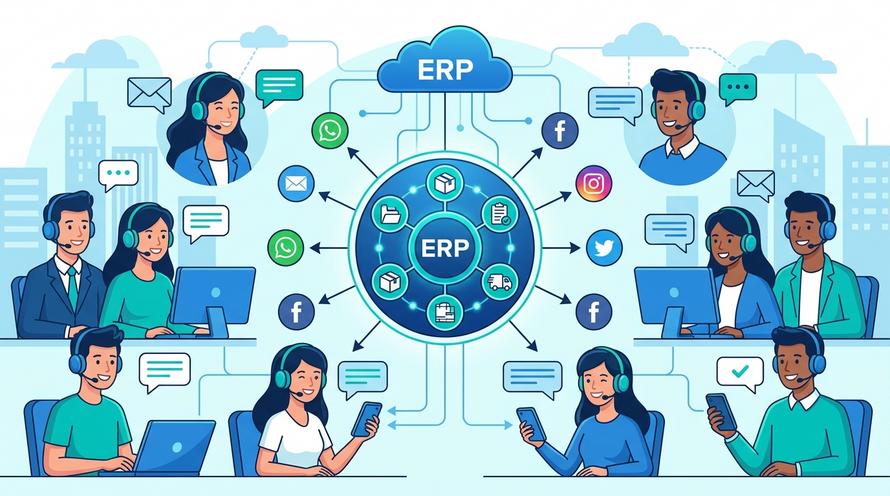
An ERP system in eCommerce is a type of software that stands for Enterprise Resource Planning. Think of it as the central nervous system for your entire online retail operation. It integrates and manages all the crucial back-end processes that happen after a customer clicks “buy,” consolidating data from various departments into a single, unified database. For scaling online businesses, this moves operations from chaotic spreadsheets and disconnected apps into a streamlined, automated workflow.
Centralized Data Management
At its core, an ERP provides a "single source of truth." All essential business data, from product SKUs and pricing to customer order histories and financial records, resides in one centralized location. This eliminates data silos and discrepancies between departments, ensuring everyone from the warehouse manager to the finance team is working with the same accurate, real-time information.
Inventory and Order Management
This is one of the most critical functions for any eCommerce business. An ERP ecommerce system tracks stock levels across all your sales channels—your website, online marketplaces like Amazon, and any physical stores—in real time. It automates the entire order lifecycle, from receiving an order to picking, packing, and shipping, while automatically updating inventory counts to prevent overselling and stockouts.
Financials and Accounting
An ecommerce ERP system automates key financial processes. It manages accounts receivable and payable, generates invoices, reconciles transactions, and provides a comprehensive financial overview of your business. This allows for accurate revenue tracking and profitability analysis without the tedious manual work of reconciling data from different payment gateways and sales platforms.
Supply Chain and Warehouse Management
Beyond just tracking inventory, an ERP helps manage the entire supply chain. It can track shipments from suppliers, manage procurement and purchase orders, and optimize warehouse operations. This ensures you have the right products in the right place at the right time, improving fulfillment speed and reducing operational costs.
Why Your Growing eCommerce Business Needs an ERP Integration
As your business grows, so does complexity. The manual processes and disconnected systems that worked for 100 orders a month will crumble under the pressure of 10,000. An ERP integration isn't just about new software; it's about building a scalable foundation for future growth by solving common operational pains.
Eliminate Manual Data Entry and Human Error
Manually re-entering order information from your Shopify store into your accounting software or a shipping spreadsheet is time-consuming and prone to costly errors. An ERP ecommerce integration automates this data flow, ensuring that information from sales, inventory, and shipping is always accurate and up-to-date, freeing up your team to focus on more strategic tasks.
Achieve a 360-Degree View of Your Customer
True customer understanding comes from combining transactional data with interactional data. When you integrate your ERP with a communication platform like Trengo, you can see a customer's entire order history right alongside their support conversations from email, WhatsApp, or live chat. This unified view allows your support team to provide highly personalized and contextual service, turning simple inquiries into loyalty-building experiences.
Make Data-Driven Decisions with Confidence
Guesswork doesn't scale. An ERP provides access to accurate, real-time reporting on key business metrics. You can analyze sales trends by channel, track inventory turnover rates, calculate customer lifetime value, and identify your most profitable products. This reliable data empowers you to make smarter decisions about marketing spend, purchasing, and overall business strategy.
Scale Operations Without Scaling Your Headcount
More orders shouldn't automatically mean more staff. By creating automation and efficiency, an ERP allows your business to handle a significantly higher volume of transactions and customer inquiries with the same team. This operational leverage is the key to profitable growth, allowing you to increase revenue without proportionally increasing overhead costs.
eCommerce Platform vs ERP: Understanding the Key Difference
Many business owners wonder if their eCommerce platform can serve as an ERP. While there's some overlap, their core functions are fundamentally different. A simple analogy is the storefront versus the back office.
Your eCommerce Platform e.g., Shopify, BigCommerce
This is your digital storefront. Its primary job is to attract customers, merchandise products effectively, and process transactions. It is expertly designed for the front-end customer experience, managing everything from the product catalog and shopping cart to the checkout process. While platforms like Shopify have some ERP-like features for basic order and inventory management, they are not true, comprehensive ERP systems.
Your ERP System e.g., NetSuite, Odoo
This is the central brain or engine room of your business. It takes over once a transaction is complete and handles all the complex operational logistics that happen behind the scenes. It manages financials, coordinates the supply chain, oversees warehouse operations, and ensures all parts of the business are running in sync. It focuses on internal efficiency and operational integrity.
How to Choose the Best ERP for Your eCommerce Business
Selecting the right ecommerce ERP system is a major decision. The best ERP is one that not only solves your current problems but also supports your future ambitions. Here’s a practical checklist to guide your evaluation process.
Assess Your Current and Future Needs Scalability
Map out your operational workflows and identify the biggest bottlenecks. Don't just solve for today; think about where your business will be in three to five years. Are you planning to expand into new countries, add wholesale channels, or launch complex new product lines? Choose a system that can scale with you.
Prioritize Critical Integration Capabilities
An ERP's value is directly tied to how well it connects with your existing technology stack. It must have robust, pre-built integrations for your eCommerce platform, payment gateways, and shipping carriers. Crucially, it should also connect to your improve your e commerce customer experience with Trengo. This connection unlocks the ability to pull real-time order data directly into customer conversations, transforming your support from reactive to proactive.
Consider Industry-Specific Features
Some ERPs are tailored for specific industries. For example, a fashion retailer needs features for managing variants like size and color, while a food and beverage company requires batch and lot tracking for compliance. Evaluate whether a general-purpose ERP or an industry-specific one is a better fit for your unique operational needs.
Understand the Total Cost of Ownership TCO
Look beyond the initial subscription or license fee. The Total Cost of Ownership (TCO) includes implementation fees, data migration costs, customization, employee training, and ongoing support. Compare the TCO of proprietary systems with open-source ERP ecommerce software, which may have lower upfront costs but require more technical resources for implementation and maintenance.
Top ERP Software for eCommerce Businesses in 2026
The ERP market is vast, but a few solutions consistently stand out for eCommerce businesses. Here are some leading systems to consider as you begin your research.
Oracle NetSuite
A true cloud-based ERP, NetSuite is a powerhouse for scaling and established eCommerce businesses. It offers a comprehensive suite of tools covering everything from financials and inventory management to CRM and eCommerce, making it a unified platform for a growing enterprise.
Acumatica
Acumatica is known for its flexible, user-friendly cloud platform and its unique pricing model, which is based on resources used rather than per-user fees. This makes it an attractive option for businesses with a large number of occasional users, such as warehouse staff.
Odoo
As a popular open-source option, Odoo offers incredible flexibility and a modular approach. Businesses can start with just the apps they need (like inventory and accounting) and add more as they grow. It's a cost-effective choice for companies with the technical know-how to manage it.
Microsoft Dynamics 365 Business Central
For businesses already invested in the Microsoft ecosystem (using Office 365 or Azure), Business Central is a natural fit. It offers deep integration with other Microsoft products and provides robust financial, supply chain, and operations management capabilities tailored for small and mid-sized businesses.
The Future of ERP and eCommerce: AI and Hyper-Automation
The role of an ERP is evolving. In 2026, these systems are no longer just passive databases but intelligent, predictive engines powered by AI. Modern ERPs can forecast demand to prevent stockouts, suggest optimal reorder points, and identify efficiency gains in your supply chain. This same wave of hyper-automation is transforming the customer experience, but only when your systems are connected.
When your ERP is integrated with an intelligent communication platform, you can create powerful, automated customer journeys. For example, trengo's AI agent can instantly access order status data from your ERP to answer "Where is my order?" inquiries via chat or email, 24/7, without human intervention. For more complex voice inquiries, an ai voice agent can tap into the ERP’s real-time inventory data to confirm product availability or process a return request over the phone. This seamless flow of data from your operational core to the customer-facing front line is the future of exceptional eCommerce service.
Frequently Asked Questions

ERP in eCommerce is a type of software that integrates and manages a company's core business processes in one unified system. It acts as a central hub for data on inventory, orders, financials, supply chain, and warehouse operations, automating workflows and providing a single source of truth for the entire business.
ERP stands for Enterprise Resource Planning. In the context of eCommerce, it refers to a software architecture designed to centralize and streamline all the operational processes required to run an online retail business efficiently.
No, Shopify is an eCommerce platform, not a full ERP system. While it excels at managing the front-end sales process, products, and basic orders, it lacks the comprehensive modules for deep financial management, supply chain logistics, and human resources that are hallmarks of a true ERP.
The top 5 ERPs for eCommerce often include Oracle NetSuite, Acumatica, Odoo, Microsoft Dynamics 365 Business Central, and SAP Business One. The best choice depends on a company's size, industry, specific needs, and budget.
Amazon uses a heavily customized, proprietary version of SAP's ERP software. Due to its immense scale and unique logistical challenges, Amazon has built a highly tailored in-house system on top of the SAP framework that is not available as an off-the-shelf product.