Comment mettre en place une stratégie marketing omnicanale


Essaie Trengo gratuitement

Trengo rassemble WhatsApp, les e-mails, le web, les réseaux sociaux et les appels dans une seule boîte de réception, ce qui fait gagner à ton équipe des heures de boulot répétitif et garantit qu'aucune conversation ne se perd.
Voir Trengo en action
- Intégrations étendues
- Configuration facile
- Structure tarifaire évolutive
Comment mettre en place une stratégie marketing omnicanale : guide complet
Résumé
Apprendre à élaborer une stratégie de marketing omnicanal est essentiel pour les entreprises modernes qui souhaitent offrir une expérience client fluide sur tous les points de contact. En 2026, les clients s'attendent à pouvoir passer sans difficulté de l'e-mail à WhatsApp et aux réseaux sociaux sans avoir à se répéter. Ce guide explore la définition du marketing omnicanal, le cadre des « 4 C » et une méthode étape par étape pour unifier ta pile de communication à l'aide d'outils comme Trengo.
TL;DR
- Une stratégie omnicanale relie tous tes canaux — e-mail, WhatsApp, réseaux sociaux, magasin — pour offrir une expérience fluide et homogène, contrairement à l'approche multicanale qui les maintient cloisonnés.
- Pour y parvenir, cartographie le parcours client, segmente et personnalise tes données, regroupe le tout dans une seule boîte de réception, harmonise le marketing et le service client, et automatise les processus grâce à l'IA et aux flowbots.
- Résultat : une meilleure fidélisation, des réponses plus rapides et une augmentation du chiffre d'affaires.
Qu'est-ce qu'une stratégie de marketing omnicanal ?
Une stratégie marketing omnicanale est une approche de contenu multicanale que les entreprises utilisent pour améliorer l'expérience utilisateur et renforcer leurs relations à tous les points de contact potentiels. Plutôt que de considérer les ordinateurs de bureau, les appareils mobiles et les réseaux sociaux comme des entités distinctes, cette stratégie part du principe que les clients peuvent entamer une interaction sur un canal et passer à un autre au fur et à mesure qu'ils avancent vers une solution ou un achat.
Il est important de faire la distinction avec le marketing « multicanal ». Le terme « multicanal » signifie simplement être présent sur plusieurs plateformes, par exemple avoir une page Facebook et un site web. Cependant, dans une approche multicanal, ces plateformes ne « communiquent » souvent pas entre elles. L'approche omnicanale les relie entre elles, garantissant ainsi que les données, le contexte et l'historique des conversations circulent de manière fluide d'une plateforme à l'autre. Si tu veux en savoir plus sur ce qu'est une stratégie de marketing omnicanal, tu peux consulter notre article.
Les 4 C de l'omnicanal
Pour comprendre la philosophie qui sous-tend cette stratégie, les spécialistes du marketing font souvent référence aux « 4 C », qui déplacent l'attention du produit vers l'utilisateur :
- Client : Concentre-toi sur la compréhension de qui est ton client, de ses besoins et de ses préférences — et pas seulement sur ce que tu vends.
- Coût : Pense au coût total pour le client, en tenant compte du temps, des efforts et des obstacles — pas seulement du prix affiché.
- Pratique : permets à tes clients d'interagir, d'acheter et d'obtenir de l'aide facilement, quel que soit le canal qu'ils préfèrent.
- Communication : Remplacer la promotion à sens unique par un dialogue bidirectionnel, en créant des interactions enrichissantes à chaque point de contact.
Pourquoi le marketing omnicanal est essentiel à la croissance
Mettre en place une stratégie unifiée n'est plus seulement une tendance ; c'est une nécessité pour assurer la croissance en 2026. En reliant tes points de contact, tu construis un écosystème de marque cohérent qui renforce la confiance.
La fidélisation de la clientèle est nettement plus élevée chez les marques omnicanales. Les statistiques montrent systématiquement que les clients qui interagissent avec une marque sur au moins trois canaux ont une valeur vie plus élevée que ceux qui n'utilisent qu'un seul canal. Lorsqu'un client se sent reconnu et valorisé, quel que soit le canal sur lequel il interagit, il est moins susceptible de te quitter.
L'augmentation du chiffre d'affaires est un autre avantage majeur. En supprimant les obstacles du processus d'achat — par exemple en permettant à un client de se renseigner via les messages privés d'Instagram et d'acheter via un lien envoyé par e-mail —, tu augmentes la fréquence des achats. De plus, la cohérence de la marque garantit que ton ton et tes offres sont identiques partout, ce qui évite la confusion qui conduit souvent à l'abandon des paniers.
Comment mettre en place une stratégie marketing omnicanale en 5 étapes
Pour mettre en place une stratégie efficace, il faut aller au-delà de la théorie et mettre en place la bonne infrastructure. Voici un guide en 5 étapes pour harmoniser tes actions marketing.
1. Cartographier le parcours client
La première étape consiste à analyser tous les points de contact entre le client et ta marque. Cela inclut ton site web, les messages privés sur Instagram, les e-mails, ton compte WhatsApp Business et les visites en magasin. En 2026, le parcours client est rarement linéaire. Un utilisateur peut découvrir un produit sur TikTok, poser une question via le chat en direct sur ton site web, puis finalement effectuer son achat grâce à une campagne de reciblage par e-mail. Tu dois cartographier ces parcours pour identifier les points de friction.
2. Segmente ton public et personnalise les données
Tu ne peux pas offrir une expérience personnalisée si tu ne sais pas à qui tu t'adresses. L'utilisation des données CRM te permet de segmenter ton public en fonction de son comportement et de son historique. Par exemple, si un client vient d'acheter un manteau d'hiver, ta stratégie omnicanale devrait cesser de lui proposer des publicités pour ce manteau et lui envoyer plutôt un « guide d'entretien » par e-mail ou SMS.
3. Harmonise ton infrastructure de communication
C'est l'étape technique la plus cruciale. Tu ne peux pas mettre en œuvre une stratégie omnicanale efficace si ton équipe doit sans cesse passer d'une application à l'autre pour consulter ses messages. Pour y remédier, les entreprises doivent centraliser leur communication.
En utilisant une boîte de réception unifiée, tu peux intégrer WhatsApp et Instagram aux e-mails et aux appels, offrant ainsi à ton équipe une vue d'ensemble du client. Ainsi, si un client pose une question sur Facebook Messenger, l'agent qui répondra par e-mail saura exactement de quoi il a été question auparavant.
4. Combler le fossé entre le service client et le marketing
Dans de nombreuses entreprises, le marketing attire les clients, mais c'est le service client qui les fidélise. Une stratégie mal coordonnée conduit souvent à des situations embarrassantes, comme lorsqu'un client reçoit un e-mail promotionnel pour son anniversaire alors qu'il est en plein conflit avec ton service client.
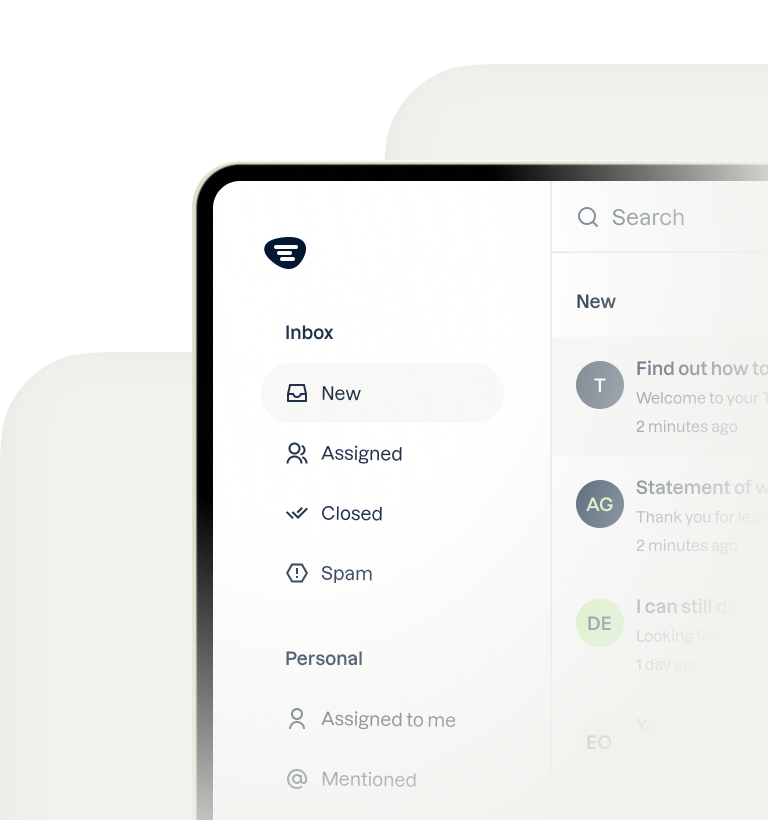
L'utilisation d'un outil collaboratif comme Trengo permet de combler ce fossé. Comme la boîte de réception est partagée, les équipes marketing peuvent consulter les tickets d'assistance ouverts avant de lancer leurs campagnes. Les fonctionnalités de collaboration, telles que le marquage interne et l'attribution des conversations, garantissent que le marketing et l'assistance travaillent main dans la main plutôt que l'un contre l'autre.
5. Mettre en place l'automatisation et les Flowbots
Un véritable marketing omnicanal implique d'être disponible 24 heures sur 24, 7 jours sur 7. Cependant, maintenir une équipe d'agents humains à disposition en permanence coûte cher. C'est là que l'automatisation devient indispensable. Tu peux déployer l'agent IA de Trengo sous forme de chatbot automatisé pour traiter les demandes courantes, qualifier les prospects et même traiter les commandes pendant que ton équipe dort.
Par exemple, les Flowbots de Trengo peuvent guider un client tout au long d'une procédure de retour sur WhatsApp ou répondre à des questions sur les prix via le chat en direct de ton site web. Si le bot ne parvient pas à résoudre le problème, il transfère la conversation en toute transparence à un agent humain dès le lendemain matin, garantissant ainsi que la « campagne » ne s'arrête jamais.
6. Regroupe toutes tes communications dans une seule boîte de réception
Une boîte de réception dispersée entraîne des messages manqués et des réponses tardives. C'est là que Trengo entre en jeu. En regroupant tous tes canaux de communication au même endroit, tu peux répondre plus rapidement et avec une meilleure compréhension du contexte, ce qui te permet de ne laisser passer aucune conversation.
Les résultats sont concrets. Comme le montre cette étude de cas avec Innovadis, Chatkracht et ContactOns, les agences qui utilisent la boîte de réception omnicanale de Trengo ont aidé leurs clients à réduire leurs délais de réponse de 40 % et à augmenter la satisfaction client de 30 %.
Exemples de stratégies de marketing omnicanal
Pour voir comment ça marche en pratique, examinons deux cas de figure différents.
Exemple dans le commerce de détail : un client achète une paire de chaussures en ligne mais souhaite les retourner. Il lance la procédure de retour via WhatsApp en discutant avec le Flowbot de la marque. Le bot génère un code QR et l'envoie par e-mail au client. Ce dernier se rend ensuite en magasin, scanne le code QR et dépose les chaussures sans avoir à expliquer le problème au vendeur. Les données ont été synchronisées entre WhatsApp, l'e-mail et le système de point de vente.
Exemple SaaS/B2B : un prospect potentiel consulte la page des tarifs d'un logiciel et y reste plus de 30 secondes. Cela déclenche l'ajout d'un chat en direct à l'interaction sur ton site web. Le prospect pose une question sur les fonctionnalités destinées aux entreprises. L'équipe commerciale n'est pas disponible, le chatbot recueille donc son adresse e-mail. Le lendemain, un commercial assure le suivi par e-mail, en faisant référence à la question posée lors du chat, et planifie une démonstration. La transition entre le comportement sur le site web, le chat et l'e-mail est fluide et personnalisée.
Questions qu'on se pose souvent (FAQ)
Comment mettre en place une stratégie omnicanale ?
Pour mettre en place une stratégie omnicanale, tu dois cartographier le parcours client, segmenter les données de ton audience, regrouper tes canaux de communication dans une boîte de réception commune, coordonner tes équipes marketing et d'assistance, et mettre en place des outils d'automatisation comme Flowbots pour garantir un engagement cohérent.
C'est quoi la règle du 3-3-3 en marketing ?
La règle du 3-3-3 indique que tu disposes de 3 secondes pour capter l'attention d'un prospect, de 30 secondes pour le captiver avec ton contenu et de 3 minutes pour le convertir ; la cohérence omnicanale s'avère particulièrement utile lors de la phase des « 3 minutes pour convertir », car elle élimine les obstacles et renforce la confiance.
Qu'est-ce qu'une campagne omnicanale ?
Une campagne omnicanale, c'est une initiative marketing spécifique, comme une promotion pour le Black Friday, où l'offre, le message et l'identité visuelle sont identiques et accessibles en même temps par SMS, e-mail, réseaux sociaux et en magasin, pour offrir une expérience cohérente.
Plus de détails



Rencontrons-nous
Développe ton activité grâce à la fidélisation. Rassemble tous tes contacts avec les clients sur une seule et même plateforme pour débloquer l'enchantement à chaque étape.